


At least five of the current Kiwi batters share an affliction of inswing, yet they are the best batters versus swing in the world.
The CricViz Twitter handle is cricket’s costless financial adviser. When it shares, you buy unquestioningly.
Yet it must be taken with a pinch of salt when it suggests that half the current crop of New Zealand batters may have an inswing problem. New Zealand are, after all, dynamites against swing. Between 2018 and 2021, no team averaged more than 27 against swing bowling except New Zealand. And if you think it was close, you’d be wrong – the Kiwis averaged 32.
That they still find it hard when the ball flits in is hard to imagine, yet it may be true. At various points in the last 3 years, Tom Latham has averaged 17, and Blundell and de Grandhomme 18 and 19 respectively against in-seam. And though it has not come to haunt him yet in Tests, 92% of Conway’s edges are inside edges. A fourth of Will Young’s wickets are bowled or leg before wicket.
Taken together, that is not definitive endorsement that the Kiwis struggle against inswing, but there is abundant evidence that they struggle against at least the inward angle.
And that’s weird enough, because they bat with cleaver knives against all pace in cricket. Since 2017, they average 38 to Test speedsters while the world average is eleven runs less. Talk about the individual purveyors of this monstrosity, and it’s just as stupid. Blundell averages 54 against outswing, de Grandhomme 51, and Latham 37. It’s as though you examined the head of the woman with the thickest locks you’ve ever seen and discovered that the scalps are rife with infection. It just doesn’t add up.
What makes it all the more interesting is the fact that this incongruous inswing rut seems to stem from the same technical tantrum. Blundell, Conway, Young, de Grandhomme and Latham all plant their front foot across the line of the off stump too often while playing on the front foot.
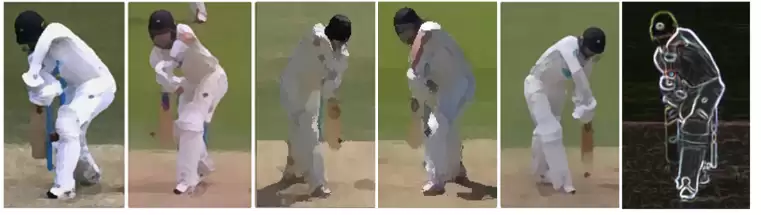
That’s the classic Cam Green paradox, so named because when the Australian allrounder found himself prey to the same knot it received agenda-setting attention. The paradox is two-fold. Because the front foot is planted across the line of the off stump, it blocks the path of the bat’s downswing – the opposite effect achieved by clearing the front leg. As a result, the player becomes susceptible to the slightest inswing. And because the front leg is so twisted, the torso twists itself too in the opposite direction to lend the body any balance. The head falls over, and judgment of off stump flays. Leg before’s and bowled outs galore.
So there is a correlation: the Kiwi chronicles are a concurrence of inswing weakness and the Cam Green paradox. And since we know that planting the front leg in the way of the bat swing causes inswing woes, it makes sense to conclude that the Green paradox is the causal route to the five New Zealand batters’ despair.
What now begs the question is whether these mirror a larger domestic trend or whether we’re scrounging for fish in a net that has turned out only five.
That’s very interesting, because if it is a larger domestic trend then it cannot be the product of a domestic inflation of a specific type of bowler (like Asia producing few leftie bats because there are too many offspinners at lower levels). Both left-handers and right-handers seem to have this issue, and if it was such bowling type inflation that caused this idiosyncrasy then it must have caused different effects to left- and right-handed batters because the same bowling type does different things to leftie and rightie batters. Remember, inswing to Conway is basically outswing to Young.
Inflation of this sort eliminated, what else could it be a result of? These are the things that follow in the bowling chain. Say, specific ball trajectory – like Indian batters committing forward instinctively because they play loads of spin at home and it’s important to get fully forward to conquer spin – or coaching idiosyncrasies – like Australian batters preferring the bat-down technique because that’s what coaches endorse.
But it’s also possible that no such generalizable trend exists, and these five Kiwis are just oddballs. It’s what Michael Wagener, leading cricket writer and statistician, thinks. “I don’t think it’s a general problem, more one specific to those players,” he mulls. Honestly, there is no straightforward answer. But this is largely irrelevant to the fact that New Zealand do extremely well against swing bowling, an utterance that’s still an understatement because they play in sufficiently swing-friendly home conditions.
Part of this pedigree could simply be explained by the fact that they are exceptional players of outswing (like Blundell, Latham and de Grandhomme are). Though arguably, a more important cog in the wheel is that they are a congregation of different-handed batters. 3 out of their top 7 in the Edgbaston Test were left-handers – one more than the number of lefties found in the average team since 2017. It is a familiar strategy for teams in T20 to “shield” their right-hander with a southpaw, especially against spin, mostly because spin is the only type of bowling that gets lateral movement. But that’s not the case in Tests in the bowling era: loads of bowlers get swing, and loads of bowlers are either inswing or outswing bowlers, not both.
Stuck with two batters at the crease whose weaker suits are inswing, whether by generalizable coaching defect or plain old luck, it’s more desirable that they be a different-handed batting pair than a same-handed pair. For against the latter, the inswing-bowling inward-angling pacer gets six cracks at a vulnerable player; against the former it’s six or fewer for sure, and routinely much less.
It’s not much, but it may have been enough to subdue the Indian team’s advantage heading into the World Test Championship Final last year: the Indians are inswing bowlers, and the left-handed Devon Conway rose in stature two Tests before the Final.
This also highlights a major point. The southpaw’s rise from representing 14% of international cricketers in the 1950s to more than doubling it in the years after has been largely attested to two important factors. Reduced stigma, and novelty-induced proficiency. A third reason is that they make the right-hander’s bed cosier. They plough the field, but also birth blonder grains. Almost like the wingman who not only made you seem the better romantic prospect but also clinked glasses with party bigwigs and launched your professional networks.
And while the rest of us have been too dizzy to document, New Zealand have weaponized that. The most successful swing hitters of our era detest one of the two main types of swing, yet they are better than everybody else.